Notenz vs Bitwarden Emergency Access: Free Doesn't Mean Automatic
June 17, 2026
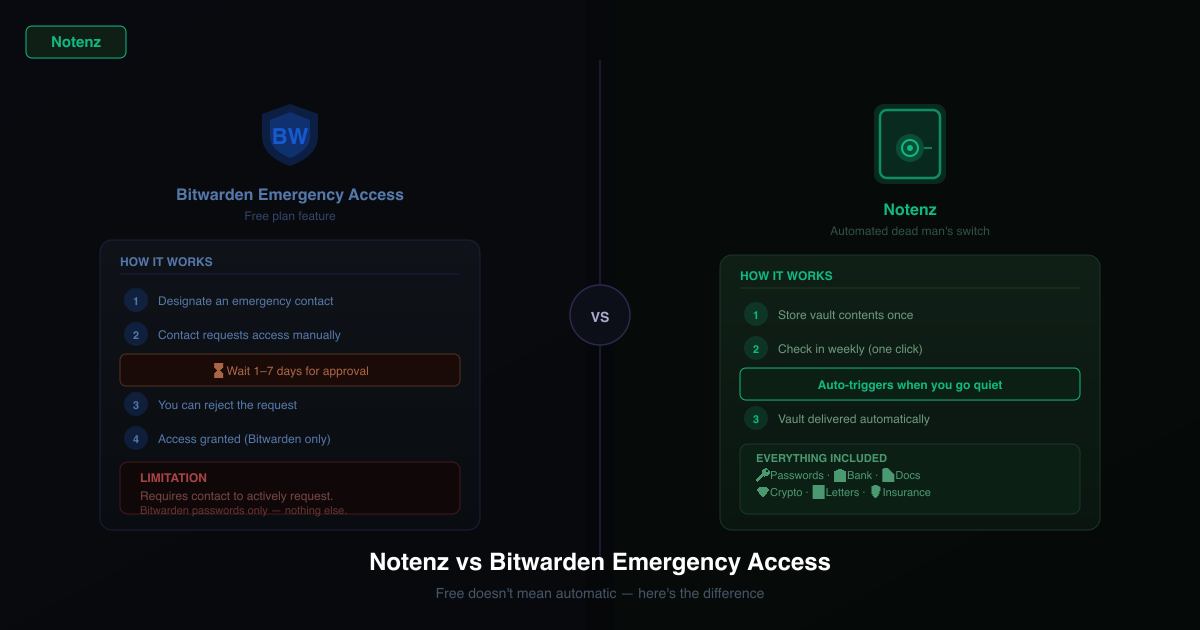
Bitwarden's Emergency Access is one of the best reasons to recommend Bitwarden over other password managers: it's available on the free plan, not locked behind a family or business tier. That makes it worth setting up no matter which password manager you use as a comparison point. But like every emergency-access feature built into a password manager, it solves a narrower problem than people assume.
How Bitwarden Emergency Access works
You invite someone as an emergency contact and set a wait time, anywhere from no wait up to 30 days. At any point, that person can send an access request. If you don't respond before the wait time elapses, they're granted either view access to your vault or, if you've configured it, the ability to take over the account entirely.
What it does well
- It's available on Bitwarden's free plan, no premium subscription required
- You can choose between read-only access and a full account takeover
- The wait time gives you a window to decline a request you didn't expect
Where it falls short
Someone has to actively request access. Emergency Access doesn't notice if you've gone quiet. Your emergency contact has to know something is wrong and remember that this feature exists, and then start the request themselves. If they don't, nothing happens.
It only covers what's inside Bitwarden. Final wishes, instructions for what to do next, video messages, files like insurance documents or a crypto seed phrase: none of that lives in a password manager.
And the same circular problem applies. Emergency Access only helps if your contact can get into Bitwarden in the first place. If your Bitwarden account itself is locked, forgotten master password, lost 2FA device, this feature can't help, because it's a feature of the account that's locked.
How Notenz fits around it
Notenz isn't a password manager and doesn't try to be. It covers the parts a password manager structurally can't:
- Automated detection. A check-in on a schedule you set, weekly is common, with reminders across multiple channels before anything is delivered
- Your Bitwarden master password itself. Guardian's Recovery Vault is a zero-knowledge encrypted note, the right place for your Bitwarden (or any) master password and 2FA recovery codes
- Everything that isn't a login. Final wishes, account-by-account instructions, video messages, and files up to 250MB, all encrypted and delivered to the right people
- Staged and split delivery. Different items to different people, with different delays
The honest recommendation
If you use Bitwarden, turning on Emergency Access costs nothing and takes a few minutes, so do it. Then use Notenz for the layer Emergency Access can't reach: the automated check-in that notices when something's wrong, and the vault for everything that lives outside your password manager, including the master password to your password manager itself.
If you use 1Password instead, the same trade-offs apply, see our 1Password Emergency Access comparison. And for everything beyond your password manager, our digital estate planning checklist covers the rest.
Related Articles
-
Why we retired the free plan
Jul 23, 2026
-
How to Add Notenz to Your Home Screen (iOS and Android)
Jul 2, 2026
-
Digital Legacy Planning: A Practical Guide for Financial Advisors
Jun 28, 2026