Why a Shared Google Doc Is Not Enough
June 21, 2026
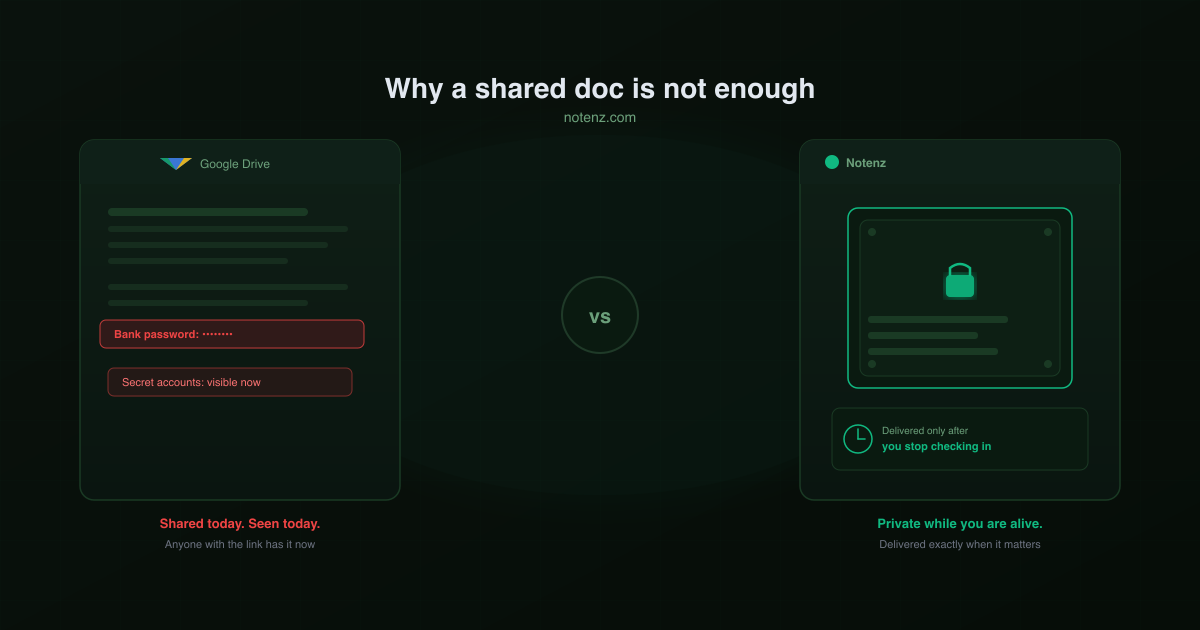
"I'll just drop everything in a Google Doc and share it with my family." It's a reasonable first instinct, and a lot of people stop there. It feels like a complete plan. It solves one problem and quietly creates two new ones that most people don't notice until they've already shared the link.
The problem isn't access. It's timing.
The moment you share that document, your family has it. Not "in case something happens." Right now. Today. Permanently. Your bank password, your email recovery codes, your private accounts, all visible from the second you hit share, whether or not anything has actually happened to you.
That's a strange trade to make. You're not trying to give your family access today. You're trying to make sure they have access on a day that, with any luck, never comes. A shared document can't tell the difference between those two situations. It's open the same way, every day, starting now.
Trust today isn't trust forever
Life is complicated, and who you'd trust with full access to your accounts can change. A relationship ends. A family member you were close to drifts. Someone's circumstances change in a way that makes them a risk you didn't see coming. The people you'd hand your passwords to today aren't guaranteed to be the same people five years from now.
A shared folder gives you no real control over that. You can revoke access if you remember to and catch it in time, but the document doesn't expire on its own, doesn't ask you to reconfirm anything, and doesn't know your life has changed. It just sits there, open, until someone manually goes back and closes it.
What a shared doc can't do
- No timing. It can't wait until you're actually gone. It's either shared or it isn't, starting the moment you click the button.
- No encryption that matters. Anyone with the link, or anyone who gets into the account that owns the doc, can read everything in it. Plaintext passwords sitting in a document are a single point of failure.
- No way to keep it current. You change a password, the document doesn't know. Most shared docs go stale within months, and nobody finds out until the moment they actually try to use one.
- No automatic trigger. Somebody still has to remember the document exists, remember where to find it, and know when it's actually time to look.
What you actually need
Not just accessibility. Timing. The information should reach your family when something has actually happened to you, not before, and not as an unconditional standing grant. Encrypted and private while you're around to manage it yourself, delivered automatically the moment it's actually needed.
How Notenz solves this
Your vault stays encrypted and private for as long as you're checking in. There's nothing for anyone to read, no live document sitting open in a shared drive. If you ever stop responding to check-ins, your vault is delivered automatically to whoever you've designated, with exactly what you decided they should receive. Same information your family would actually need, sealed until the timing is right instead of open the whole time.
Notenz is a dead man's switch for your digital life. Store passwords, accounts, and important documents in an encrypted vault. Check in periodically. If you ever go quiet, the right people get access automatically, not a day sooner.
See how Notenz worksRelated Articles
-
Why we retired the free plan
Jul 23, 2026
-
How to Add Notenz to Your Home Screen (iOS and Android)
Jul 2, 2026
-
Digital Legacy Planning: A Practical Guide for Financial Advisors
Jun 28, 2026